Introduction
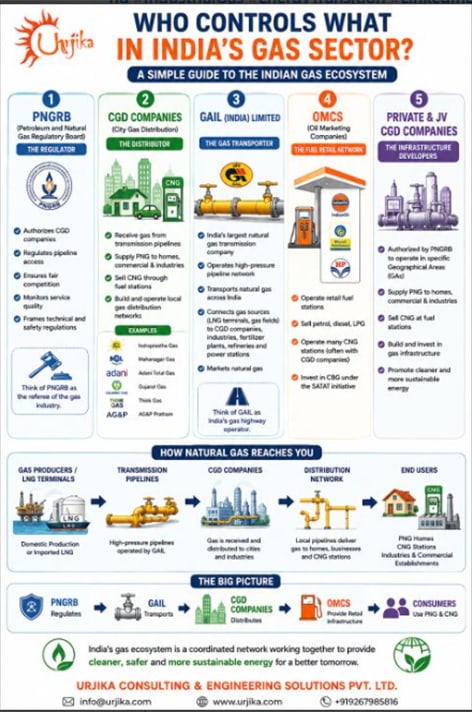
India’s City Gas Distribution (CGD) sector plays an important role in expanding access to natural gas for households, commercial establishments, industries and vehicles.
The Petroleum and Natural Gas Regulatory Board (PNGRB) authorises entities to develop CGD networks in designated Geographical Areas (GAs), subject to the applicable legal and regulatory framework.
A CGD authorisation is more than a regulatory approval. It provides the framework within which an authorised entity can develop gas distribution infrastructure, connect customers and build its business in a defined area.
Understanding CGD authorisations helps professionals recognise how the industry expands, how companies compete for new markets and why long-term infrastructure investment matters.
What Is a Geographical Area (GA)?
A Geographical Area is a defined territory for which an entity receives authorisation to develop a CGD network under the applicable regulatory framework. Depending on the authorisation, it may cover a city, district or multiple districts.
The network may supply:
- Domestic PNG: Natural gas for household cooking.
- Commercial PNG: Gas for hotels, restaurants and other businesses.
- Industrial PNG: Gas for eligible industrial applications.
- CNG: Compressed natural gas supplied through authorised station networks for vehicles.
The authorised entity must meet the applicable development obligations, technical requirements and regulatory conditions.
Important clarification: A CGD authorisation does not automatically mean unrestricted exclusivity over every gas-related activity in the area. The scope and duration of exclusivity depend on the applicable regulations, authorisation terms and the specific infrastructure or activity concerned.
Why Is a CGD Authorisation Valuable?
Defined Market Opportunity
An authorised GA provides a defined area in which a company can plan and develop its CGD network, subject to regulatory conditions. This helps the company establish its infrastructure and customer-acquisition strategy.
Infrastructure Development Advantage
Developing underground pipelines, CNG stations, city gate stations and associated facilities requires significant capital, planning and coordination. Existing infrastructure can provide an advantage as the network and customer base expand.
Potential for Recurring Revenue
Once infrastructure is developed and customers are connected, the company may generate revenue through natural gas sales and related distribution activities. Actual returns depend on demand, tariffs and pricing, operating costs, utilisation, competition and capital investment.
High Barriers to Entry
Building a distribution network requires investment, technical expertise, permissions, land access and long-term project execution. These factors can make entry into an established market challenging.
Long-Term Business Planning
Authorisation conditions and development commitments influence decisions about pipeline construction, CNG station rollout, customer connections and future capital expenditure.
How Do PNGRB Bidding Rounds Work?
PNGRB invites eligible entities to participate in authorisation processes for designated GAs, in accordance with the applicable regulations and bidding framework.
At a high level, the process involves:
- Identification of geographical areas: Areas are identified for potential CGD network development.
- Invitation to bid: Eligible entities submit bids in accordance with the published requirements.
- Evaluation and authorisation: Bids are assessed under the applicable framework, and successful entities receive authorisation.
- Infrastructure development: The authorised entity plans and develops the network and associated facilities.
- Regulatory compliance: The entity works toward its authorised development commitments and ongoing obligations.
Companies participating in India’s CGD sector include Adani Total Gas, Torrent Gas, THINK Gas, IGL, MGL, Gujarat Gas and other authorised entities, including businesses associated with GAIL.
The companies and areas participating in any particular bidding round depend on the official notification and bid conditions.
Practical Case Example: Developing a New CGD Network
Consider a company that receives authorisation to develop a CGD network in a growing geographical area.
The company must plan its investment and execution strategy to connect households, commercial customers, industries and CNG stations over time.
Its work may include:
- Assessing gas demand and potential customer clusters.
- Planning pipeline routes and network infrastructure.
- Developing CNG stations and associated gas-handling facilities.
- Procuring compressors, cascades, dispensers, valves and fittings where required.
- Coordinating engineering, installation, commissioning and safety requirements.
- Managing customer connections, maintenance and ongoing operations.
The business opportunity depends not only on obtaining the authorisation but also on executing the development plan effectively and building sustainable demand.
This example illustrates the relationship between regulatory authorisation, infrastructure investment and commercial growth. It is illustrative rather than a report of a specific company’s project.
Why Companies Compete for CGD Geographical Areas
Companies evaluate several factors before bidding for a GA:
- Demand potential: Population, industrial activity, transport demand and likely gas consumption.
- Infrastructure requirements: Pipeline length, station requirements, land availability and development complexity.
- Investment commitments: Capital required to meet development plans and regulatory obligations.
- Commercial viability: Expected sales, costs, pricing conditions and potential returns.
- Execution capability: Access to engineering expertise, suppliers, contractors and project-management resources.
- Long-term strategy: How the GA fits into the company’s existing network and future business plans.
A large population or industrial base does not automatically make a GA profitable. Commercial success depends on the combination of demand, investment, execution and operating conditions.
How CGD Expansion Creates Opportunities for the Supply Chain
The development of new CGD networks can create demand for products and services across the gas infrastructure ecosystem, including:
- Gas compressors and CNG storage cascades
- CNG dispensers and station equipment
- High-pressure tubing, manifolds, valves and fittings
- Pressure regulation and metering systems
- Gas detection and quality-monitoring equipment
- Pipeline construction and engineering services
- Installation, commissioning and maintenance
For equipment manufacturers, engineering companies and technical sales professionals, understanding where CGD infrastructure is being developed can help identify potential project requirements and customer opportunities.
However, procurement demand depends on the project’s actual stage, specifications, budgets and purchasing schedule.
Relevance to Urjika Consulting & Engineering Solutions Pvt. Ltd.
Urjika works in the CNG, CBG and clean-energy infrastructure ecosystem, providing solutions such as compressors, storage cascades, dispensers, LCV fill posts, high-pressure tubing and related engineering services.
Understanding CGD authorisations and network development helps Urjika’s teams connect industry expansion with potential equipment and project-execution requirements.
For technical sales and business development, this knowledge can support better market research, customer identification, tender monitoring and discussions with CGD companies, EPC contractors and project developers.
Key Takeaways
- A CGD authorisation enables development of a network in a designated geographical area, subject to regulatory conditions.
- Exclusivity is governed by the applicable framework and should not be assumed to cover every activity indefinitely.
- Authorisation creates an opportunity, but it does not guarantee profitability.
- Infrastructure development can generate opportunities for equipment suppliers, engineering companies and skilled professionals.
- Long-term success depends on demand, investment, compliance, execution and operational performance.
Conclusion
A CGD authorisation is a significant strategic asset because it establishes the regulatory framework for developing gas distribution infrastructure within a defined market.
For CGD companies, it can create a long-term growth opportunity. For the wider supply chain, it can signal potential demand for equipment, engineering, construction and maintenance services.
Understanding the authorisation framework helps industry professionals look beyond the licence itself and recognise the infrastructure, investment and execution needed to build a successful gas distribution network.
Understand the authorisation. Identify the opportunity. Build the infrastructure.