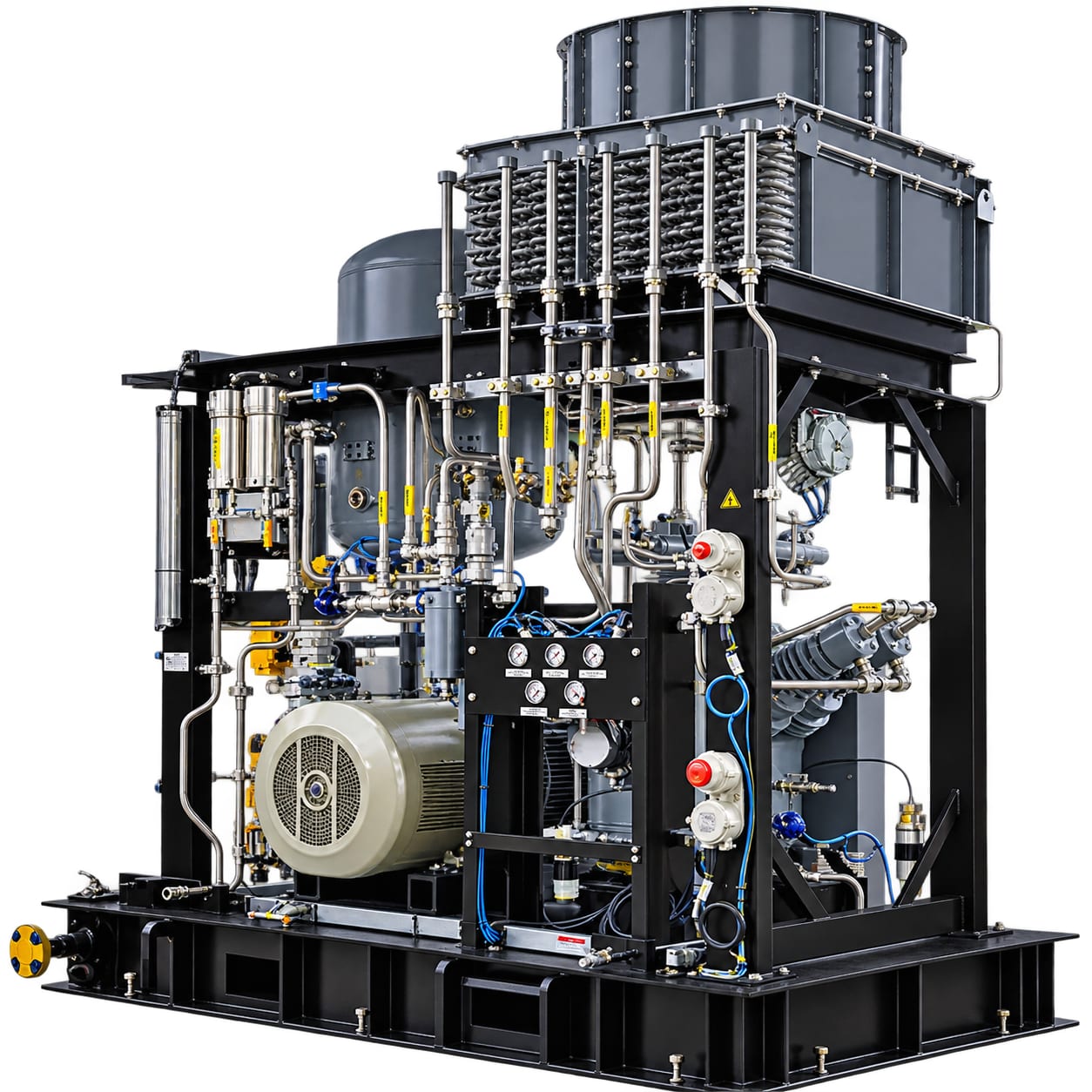
Type 1 steel and Type 3 / Type 4 composite cylinder cascades from 50 WL to 9600 WL — designed, fabricated and tested in-house at our Greater Noida plant.
Impact analysis in all six directions for every model
1,920 kg
Maximum gas carrying capacity (Type 1, 9600 WL)
Overview
Storage and transport built around your vehicle, site and throughput
A cascade is a bank of high-pressure cylinders connected through a common manifold. It stores CNG or CBG at up to 255 bar and releases it to dispensers, fill posts, decompression units or pipelines. Urjika builds stationary cascades for CNG and CBG stations and mobile cascades that ride on 6-wheel and 10-wheel CNG trucks for mother–daughter supply.
Every cascade is engineered in-house — from frame design and 4G FEA simulation to fabrication by WPS/PQR-qualified welders and Swagelok-trained tubing technicians, hydrotesting and PESO documentation. We size each cascade to the payload of your vehicle so you carry the maximum legal gas per trip.
Cylinder technology
Three cylinder types, one engineering standard
Type 4 · Polymer liner + composite
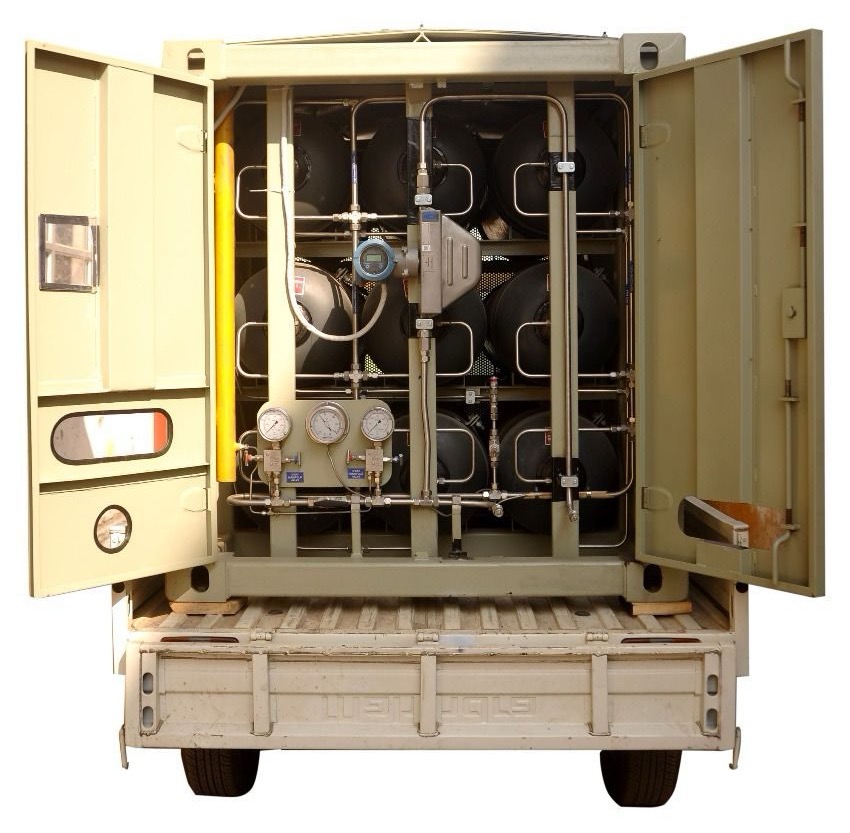
Type 4 Composite Cascade (9540 WL)
Non-metallic polymer liner with carbon-fibre overwrap in a containerised, ISO-style enclosure — the lightest option available.
36 × 265 WL composite cylinders
1,800 kg gas @ 250 bar & 15°C
Total weight with gas: 8.1 t — fits a 22 ft MCV
Type 1 · All-steel
Type 1 Steel Cylinder Cascades
Seamless chromium–molybdenum steel cylinders — the proven, cost-effective choice for stationary storage and mobile transport.
50 WL to 9600 WL, single or three-bank
75 WL and 150 WL PESO & BIS approved cylinders
500+ delivered across 19+ states
Type 3 · Metal liner + composite
Type 3 Composite Cascades
Seamless aluminium liner fully wrapped in carbon fibre — significantly lighter than steel for higher payload per trip.
Available in 7200, 8400 and 9600 WL
200 WL composite cylinders
Up to 1800 kg gas per trip
Model range
Type 1 CNG/CBG cascades
Size (Model)
Cylinder Config.
Dimension L×B×H (m)
Cascade Weight (t)
Gas Capacity @250 bar & 15°C (kg)
Gas Utilization @85% (kg)
Total Weight with Gas (t)
Vehicle Make
Vehicle Model (CNG)
Vehicle Payload (kg)
3000 WL
75 WL × 40 Cyl
3.47 × 1.86 × 1.82
5.40
600
510
6.00
Eicher
Pro 1095XP CNG - 6W
7,220
3000 WL
150 WL × 20 Cyl
2.6 × 2.13 × 2.2
5.20
600
510
5.80
Eicher
Pro 1095XP CNG - 6W
7,220
4500 WL
75 WL × 60 Cyl
4.9 × 1.86 × 1.88
8.20
900
765
9.10
Eicher
Pro 2114XP CNG - 6W
10,631
4500 WL
150 WL × 30 Cyl
3.47 × 1.86 × 1.82
7.74
900
765
8.64
Eicher
Pro 2114XP CNG - 6W
10,631
5400 WL
150 WL × 36 Cyl
3.87 × 2.13 × 2.2
9.30
1,080
918
10.38
Eicher
Pro 2114XP CNG - 6W
10,631
6000 WL
150 WL × 40 Cyl
4.33 × 2.13 × 2.2
10.30
1,200
1,020
11.50
Tata
Ultra T.19 CNG - 6W
12,600
6600 WL
150 WL × 44 Cyl
5.08 × 2.14 × 2.2
11.00
1,320
1,122
12.32
Tata
Ultra T.19 CNG - 6W
12,600
7200 WL
150 WL × 48 Cyl
5.1 × 2.13 × 2.2
12.36
1,440
1,224
13.80
Tata
Signa 2818.T CNG - 10W
18,500
7800 WL
150 WL × 52 Cyl
5.6 × 2.14 × 2.3
13.42
1,560
1,326
14.98
Tata
Signa 2818.T CNG - 10W
18,500
9000 WL
150 WL × 60 Cyl
6.4 × 2.13 × 2.3
15.76
1,800
1,530
17.56
Tata
Signa 2818.T CNG - 10W
18,500
9600 WL
150 WL × 66 Cyl
6.9 × 2.14 × 2.3
16.50
1,980
1,683
18.48
Tata
Signa 2818.T CNG - 10W
18,500
Gas utilization is calculated at 85% of stored gas. Vehicle make and model are indicative matches based on registered payload; alternate CNG vehicles can be matched on request.
Model range
Type 3 / Type 4 composite cylinder cascades
Size (Model)
Type
Cylinder Config.
Dimension L×B×H (m)
Cascade Weight (t)
Gas Capacity @250 bar & 15°C (kg)
Gas Utilization @85% (kg)
Total Weight with Gas (t)
Vehicle Make / Model
Vehicle Payload (kg)
9600 WL
Type 3
200 WL × 48 Cyl
4.6 × 2.4 × 2.5
9.90
2,050
1,743
11.95
Tata Ultra T.19 CNG - 6W
12,600
8400 WL
Type 3
200 WL × 40 Cyl
4.6 × 2.4 × 2.0
8.30
1,800
1,530
10.10
Eicher Pro 2114XP CNG - 6W
10,631
7200 WL
Type 3
200 WL × 36 Cyl
4.2 × 2.4 × 2.0
7.45
1,550
1,318
9.00
Eicher Pro 2114XP CNG - 6W
10,590
9540 WL
Type 4
265 WL × 36 Cyl
5.8 × 2.05 × 2.5
6.30
1,800
1,530
8.10
Eicher Pro 2114XP CNG - 6W
10,631
Type 3 cascades are available in all three ranges (7200, 8400 and 9600 WL). Made in India composite cylinders with lead time of 8 weeks maximum.
Technical specifications
Built component by component
Type 1 cylinders
Standard
IS 7285 (Part 2): 2017
Approvals
PESO & BIS
Material
Chromium–molybdenum steel (34CrMo4)
Working pressure
255 bar(g) at 15°C
Hydraulic test pressure
375 bar(g)
Min. burst pressure
600 bar(g)
150 WL cylinder
Ø 356 mm × 1,910 mm, approx. 210 kg, approx. 30 kg gas
75 WL cylinder
Ø 267 mm × 1,700 mm, approx. 105 kg, approx. 15 kg gas
Type 3 / Type 4 cylinders
Standard
ISO 11119-2:2020 (Type 3) & ISO 11119-3:2020 (Type 4) / EN 12245
Type 3 construction
Seamless aluminium 6061 liner, full carbon-fibre wrap
Type 4 construction
Non-metallic polymer liner, carbon-fibre overwrap
Working pressure
250 bar(g) at 15°C (max. 255 bar)
Hydro / burst test
375 bar / 750 bar
Type 3 cylinder (210 WL)
Approx. Ø 415 mm × 1,970 mm, approx. 140 kg
Type 4 cylinder (265 WL)
Ø 585 mm × 1,680 mm, approx. 92 kg, approx. 50 kg gas
GI sheet canopy (approx. 0.32 m) for sun protection
Banking
Single bank or three-bank, as per application
Lifting & tie-down
Designed for crane lifting and vehicle lashing
Finish
Industrial primer + PU paint, safety signage
Testing & documentation
Welding
WPS/PQR-qualified welders
Tubing
Swagelok-trained technicians
Pressure testing
100% hydrotest and leak test of manifolds
Purging
Nitrogen purging before dispatch
Reports
FEA report, test certificates, GA & P&ID (to buyer)
Approvals
PESO approval documentation support
Why Urjika cascades
Engineered for more gas per trip and fewer surprises
Payload-Matched Sizing
Each model is matched to a CNG vehicle payload so you carry the maximum legal gas per trip.
4G FEA Validated
Frames simulated under 4G impact loads in all six directions before fabrication.
Safety Built In
Burst disc + fusible plug on every cylinder, relief valve on manifold, dedicated vent line.
Remote Pressure Monitoring
Optional wireless pressure monitoring to track stock at daughter stations.
In-House Manufacturing
Designed, fabricated, tested and dispatched from our Greater Noida plant.
PESO Documentation
Complete drawings, test certificates and approval support.
Applications
Where our cascades work
CNG Mother & Daughter Stations
Stationary storage and mobile supply for online and daughter-booster stations.
CBG Plants
High-pressure storage after compression and mobile cascades for CBG offtake.
DCU & Grid Injection
Supplying CBG to decompression units that inject into CGD networks.
Industrial Supply
Gas supply to industries, hotels and gensets beyond the pipeline network.
Gallery
Built at our Greater Noida plant
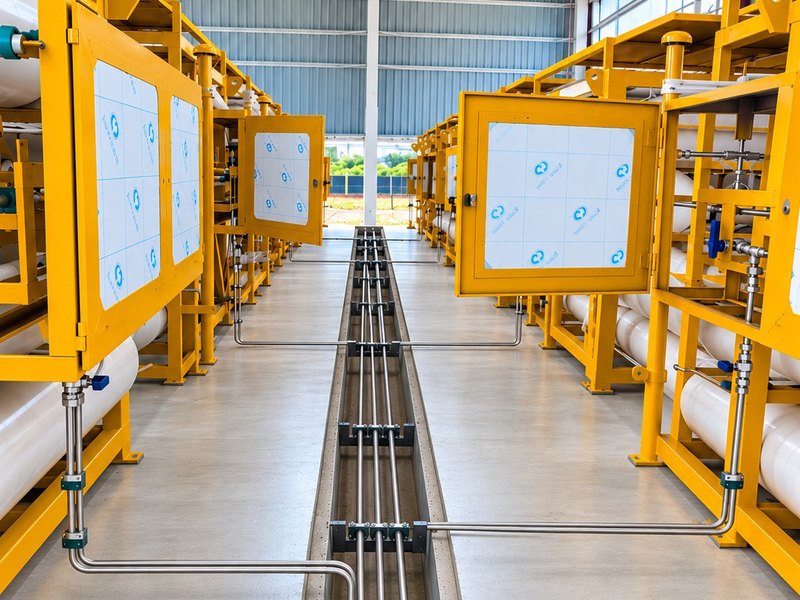
A selection of cascades fabricated, tested and dispatched from our plant in Greater Noida.
Greater Noida, U.P.
Type 4 containerised cascade · 9540 WL
Type 1 cascade · 9600 WL
Type 1 cascade · 4500 WL
200WL CNG Cascade
Type 1 stationary cascade
Type 1 CBG Cascade
Mobile cascade frame
Compact 75 WL cascade
Small-capacity cascade
FAQ
Frequently asked questions
Q.What is the difference between Type 1, Type 3 and Type 4 cascades?
Type 1 cylinders are all-steel and the most economical. Type 3 use an aluminium liner with full carbon-fibre wrap, and Type 4 use a polymer liner with carbon-fibre wrap. Composite cascades weigh far less, so a vehicle can carry more gas per trip.
Q.How much of the stored gas can actually be used?
Typically about 85% of the stored gas can be decanted, depending on the downstream compressor or booster. The table shows both total capacity and usable gas at 85%.
Q.What is the lead time for Type 3 / Type 4 cascades?
We use Made in India composite cylinders with a lead time of 8 weeks maximum for the cylinders.
Q.How do I choose the right cascade size?
Start from the vehicle you will use and its registered payload. Our model table maps each cascade to a matching CNG vehicle; our team can also size a custom configuration for your route and daily demand.
Q.What is the difference between single-bank and three-bank?
Single-bank cascades discharge as one unit and suit transport and decanting. Three-bank cascades split cylinders into low, medium and high banks for faster, more efficient sequential filling at stations.
Q.Are your cascades PESO approved?
Yes. Cylinders and valves are PESO approved, and we support complete PESO documentation for the cascade assembly.
Specifications are indicative and may vary with project requirements, applicable codes and approvals. Final data is confirmed in the project datasheet.
Need a cascade sized for your fleet?
Tell us your vehicle, route and daily volume — we will recommend the right configuration.