Introduction
India’s natural gas industry is a coordinated ecosystem involving regulators, gas transmission companies, City Gas Distribution (CGD) operators, Oil Marketing Companies (OMCs), gas producers and infrastructure providers.
Each participant has a different responsibility, from regulating the sector and transporting natural gas to distributing it to consumers and developing renewable alternatives such as Compressed Biogas (CBG).
For freshers and professionals entering the Oil & Gas industry, understanding these roles provides a foundation for learning how gas moves from its source to homes, industries and vehicles.
The Challenge: Understanding Who Does What
A common misconception is that one company controls the entire natural gas supply chain. In reality, different organisations manage different activities, and their responsibilities may overlap through commercial agreements, joint ventures and shared infrastructure.
For example, a CNG station may involve a CGD company, a land or fuel-station partner, gas suppliers, equipment vendors and contractors. Each contributes to a different part of the project.
Understanding these relationships helps professionals identify responsibilities, communicate with the right stakeholders and understand how gas infrastructure projects are developed.
Key Participants in India’s Gas Ecosystem
PNGRB — The Regulator
The Petroleum and Natural Gas Regulatory Board (PNGRB) regulates specified downstream petroleum and natural gas activities within its statutory scope.
Its responsibilities include:
- Authorising eligible entities to develop CGD networks in designated geographical areas.
- Regulating specified natural gas pipeline activities and access.
- Establishing applicable technical and safety regulations.
- Addressing relevant consumer-service and competition matters under its legal framework.
Simple explanation: PNGRB establishes and oversees the applicable regulatory framework. It does not directly operate every pipeline or CNG station.
GAIL (India) Limited — Transmission and Gas Infrastructure
GAIL is a major natural gas transmission company in India. Its activities include natural gas transportation, marketing and related energy infrastructure.
Its role can include:
- Operating natural gas transmission pipelines.
- Transporting gas between supply sources and demand centres.
- Marketing natural gas.
- Connecting gas sources with CGD entities, industries, fertiliser plants, refineries and other consumers through the relevant infrastructure and commercial arrangements.
Simple explanation: GAIL is a major part of India’s gas transportation and supply infrastructure.
Oil Marketing Companies (OMCs) — Fuel Retail and Energy Infrastructure
Major OMCs include Indian Oil Corporation Limited (IOCL), Bharat Petroleum Corporation Limited (BPCL) and Hindustan Petroleum Corporation Limited (HPCL).
Their activities include fuel marketing and retail infrastructure. Depending on the location and business arrangement, they may also participate in CNG station development, partnerships with CGD companies and initiatives involving CBG.
Their roles can include:
- Operating petrol and diesel retail networks.
- Providing or partnering in retail-station infrastructure.
- Participating in CNG dispensing arrangements.
- Supporting eligible bioenergy initiatives, including CBG-related projects.
Simple explanation: OMCs connect fuel supply and retail infrastructure with customers, while their involvement in CNG and CBG varies by project and business model.
CGD Companies — Distribution to End Users
CGD companies develop and operate authorised city gas distribution networks. Examples include:
- Adani Total Gas
- Indraprastha Gas Limited (IGL)
- Mahanagar Gas Limited (MGL)
- Gujarat Gas Limited
- THINK Gas
- AG&P Pratham
Depending on their authorisations and operating areas, their activities can include:
- Supplying PNG to domestic, commercial and industrial consumers.
- Developing and operating CNG station networks.
- Constructing and maintaining distribution pipelines.
- Connecting new customers and managing distribution operations.
Simple explanation: CGD companies bring natural gas closer to end users through local distribution networks and associated facilities.
How Do These Participants Work Together?
Consider a hypothetical project to supply natural gas to a new CNG station.
The project may involve several participants:
- Regulatory framework: The relevant authorisations, technical requirements and legal obligations are identified.
- Gas supply and transportation: Gas is sourced and transported through the applicable supply and transmission arrangements.
- CGD network connection: The authorised CGD entity coordinates the distribution connection and relevant station arrangements.
- Retail infrastructure: A station may be developed by the CGD company, an OMC or another partner under the applicable business arrangement.
- Equipment and engineering: Suppliers and contractors provide equipment such as compressors, cascades, dispensers, valves, tubing and control systems.
- Operation and maintenance: Responsible operators manage station performance, safety and customer service according to applicable requirements.
The exact roles depend on the project’s ownership, contracts, network configuration and regulatory requirements.
Where Does CBG Fit into the Ecosystem?
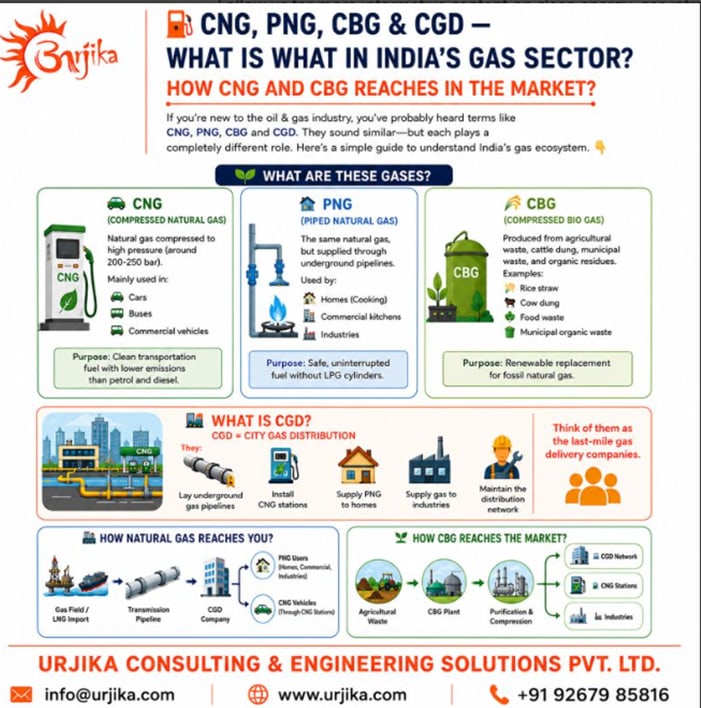
Compressed Biogas (CBG) adds a renewable-gas pathway to the wider energy ecosystem.
CBG is produced by processing biogas derived from organic materials such as agricultural residues, press mud, municipal organic waste and other suitable feedstocks.
A simplified pathway is:
Organic feedstock → Biogas production → Gas upgrading → Compression → Storage and transportation → End use
CBG producers, equipment manufacturers, infrastructure providers, OMCs and CGD companies may participate at different stages, depending on the project and the applicable supply arrangements.
CBG can contribute to renewable energy objectives while creating opportunities in plant development, gas compression, storage, gas quality monitoring, transportation and dispensing infrastructure.
Practical Case Example: Developing a CNG or CBG Supply Project
Imagine a developer planning a gas supply project that will deliver CNG or CBG to customers.
The developer may need to coordinate with gas suppliers, relevant network operators, equipment vendors, engineering contractors and regulatory stakeholders.
The project could require:
- Gas supply and demand assessment.
- Network connectivity and infrastructure planning.
- Compression and high-pressure storage equipment.
- Tubing, manifolds, valves and gas-control systems.
- Gas quality monitoring and safety systems.
- Installation, testing, commissioning and maintenance arrangements.
The project succeeds when each participant understands its responsibilities and the interfaces between different systems are properly managed.
This illustrates why knowledge of the overall gas ecosystem is useful not only for engineers but also for procurement teams, sales professionals, project managers and entrepreneurs.
Career Opportunities Across the Gas Ecosystem
| Area | Example career opportunities |
|---|---|
| Regulation and compliance | Regulatory coordination, safety and compliance |
| Transmission and pipelines | Pipeline engineering, operations and maintenance |
| CGD networks | Network development, CNG operations and PNG connections |
| Fuel retail and OMCs | Station operations, infrastructure and commercial roles |
| CBG production | Plant operations, process engineering and project execution |
| Equipment and EPC | Technical sales, procurement, installation and commissioning |
| Project management | Planning, vendor coordination and delivery management |
The skills required vary by role, but knowledge of gas infrastructure, equipment specifications, safety requirements and project execution can be valuable across multiple segments.
Relevance to Urjika Consulting & Engineering Solutions Pvt. Ltd.
Urjika works within the CNG, CBG and clean-energy infrastructure ecosystem, providing solutions such as:
- Gas compressors and storage cascades.
- CNG dispensers and LCV fill posts.
- High-pressure SS316 tubing and manifold systems.
- Pressure regulation and gas-handling equipment.
- Gas analysers and related monitoring systems.
- Installation, commissioning and engineering services.
Understanding the roles of regulators, transmission companies, CGD operators, OMCs and CBG developers helps Urjika’s teams understand project requirements and coordinate with relevant customers, contractors and stakeholders.
Key Takeaways
- PNGRB provides the regulatory framework for specified downstream gas activities.
- GAIL plays a major role in natural gas transmission, marketing and infrastructure.
- OMCs operate fuel retail networks and may participate in CNG and CBG projects.
- CGD companies develop authorised networks and supply natural gas to customers.
- CBG producers and infrastructure providers support the renewable-gas value chain.
- Equipment suppliers and EPC contractors help turn project plans into functioning infrastructure.
These organisations perform different but interconnected roles in India’s gas ecosystem.
Conclusion
India’s natural gas sector is not controlled by a single organisation. It operates through a network of regulators, transmission companies, distributors, fuel retailers, producers and engineering partners.
As CNG, PNG and renewable CBG infrastructure develops, understanding how these participants work together becomes increasingly valuable for professionals entering the energy industry.
Know the stakeholders. Understand the gas value chain. Build your future in energy.