Introduction
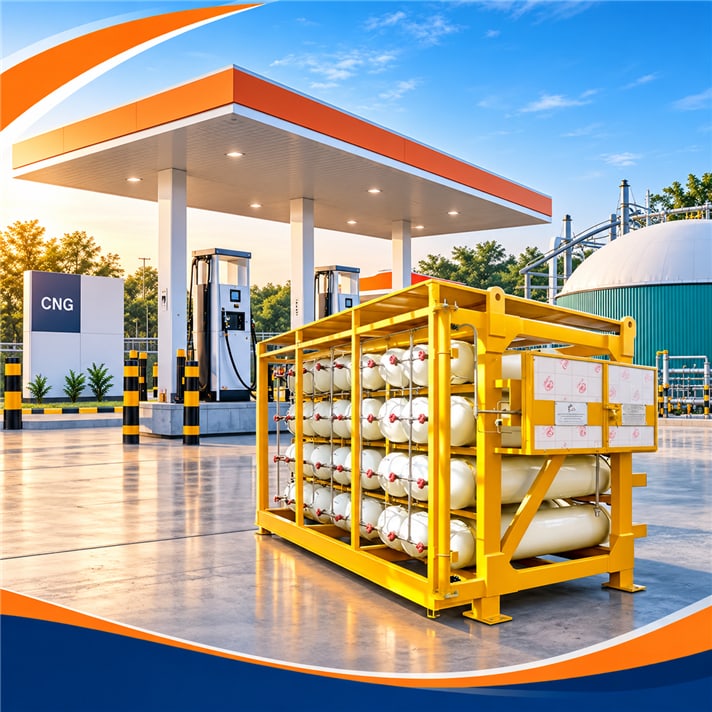
In the CNG industry, a cascade may be labelled with a capacity of 900 kg, yet the actual quantity of gas delivered during decanting may be significantly lower. This often raises questions among operators, transporters, and customers.
The reason is that a cascade’s stated capacity and its usable delivery capacity are not necessarily the same. To understand the difference, we need to examine water capacity, working pressure, gas storage conditions, and residual pressure.
Understanding Water Capacity (WL)
Water capacity represents the internal volume of a cylinder, expressed in litres. It indicates the size of the cylinder, not directly the mass of CNG it can store.
For example:
- A 75 WL cylinder has an internal water capacity of approximately 75 litres.
- A 150 WL cylinder has an internal water capacity of approximately 150 litres.
- A 4,500 WL cascade has a combined water capacity of approximately 4,500 litres.
The actual quantity of CNG stored depends on pressure, temperature, and the gas composition.
What Does Working Pressure Mean?
Working pressure is the specified pressure at which the cylinder is designed to operate under defined conditions. Many CNG cascade systems use a nominal working pressure of 250 bar, subject to the cylinder, equipment, and applicable approvals.
At high pressure, a large quantity of gas can be stored within a relatively compact volume. However, pressure alone does not determine the exact mass of gas inside the cascade.
Water Capacity vs. Gas Capacity
These two terms describe different things:
- Water Capacity (WL): The internal volume of the cylinder or cascade.
- Gas Capacity (kg): The mass of CNG stored under specified conditions.
As an illustrative industry rule of thumb, a 75 WL cylinder may hold approximately 15 kg of CNG at specified reference conditions. On the same simplified basis, a 4,500 WL cascade may be described as having a nominal gas capacity of around 900 kg.
However, this estimate is not universal. Actual capacity must be determined using the gas composition, pressure, temperature, compressibility factor, and the applicable capacity-rating basis.
The Main Challenge: Why Is the Full 900 kg Not Delivered?
Consider an illustrative scenario in which a cascade is advertised with a nominal capacity of 900 kg. During operation, the quantity delivered to the receiving system is lower than expected.
Several factors may explain the difference.
Filling pressure and temperature
The actual mass stored depends on the conditions at the time of filling. Temperature affects gas density, while the actual pressure reached during filling determines how much gas enters the cascade. The relationship is also influenced by the non-ideal behaviour of compressed natural gas.
Residual pressure after decanting
Gas transfer depends on the pressure difference between the cascade and the receiving system. As the cascade pressure falls, the transfer rate decreases. Decanting may stop while gas remains inside the cylinders because the cascade pressure is no longer sufficient for the required transfer.
Receiving-system pressure
The pressure of the receiving storage system or vehicle affects how much gas can be transferred. A higher receiving pressure can reduce the available pressure difference and limit delivery.
Operating and measurement conditions
Filling practices, cascade configuration, gas temperature, meter accuracy, and the pressure at which transfer stops can all influence the measured delivery quantity.
Illustrative Practical Example
Suppose an operator uses a cascade with a nominal gas capacity of 900 kg.
For illustration, assume the quantity delivered during a particular operating cycle is 720 kg.
- Nominal stated capacity: 900 kg
- Actual delivered quantity: 720 kg
- Difference: 180 kg
- Delivered quantity as a percentage of nominal capacity: 80%
This example demonstrates why nominal storage capacity should not automatically be treated as the quantity available for delivery in every operating cycle.
The difference of 180 kg should not automatically be classified as gas permanently trapped in the cascade. Some gas remains at the end of decanting, while the difference may also reflect the capacity-rating basis, initial filling conditions, receiving pressure, and other operating factors.
Important: A 650–765 kg delivery range from a nominal 900 kg cascade should be treated as an illustrative estimate, not a guaranteed utilization range. The actual usable quantity must be established from the cascade specifications and operating conditions.
How Can Operators Improve Planning?
Operators can take practical steps to improve capacity planning and reduce discrepancies:
- Verify the capacity basis: Confirm whether the stated kg capacity refers to nominal stored mass, a reference condition, or a specified usable delivery quantity.
- Record filling conditions: Track initial pressure, gas temperature, and filling completion conditions.
- Monitor residual pressure: Record the cascade pressure at the end of decanting.
- Measure delivered gas: Use suitable, calibrated measurement equipment and consistent reference conditions.
- Review receiving-system requirements: Consider the receiving pressure and the required final pressure before estimating usable delivery.
- Analyse operating data: Compare multiple filling and decanting cycles rather than relying on a single observation.
Filling during cooler periods may sometimes help with temperature-related operational considerations, but it does not guarantee a particular delivered mass. Filling pressure, temperature stabilisation, compressor operation, and approved procedures must all be considered.
Relevance to Urjika Consulting & Engineering Solutions Pvt. Ltd.
For CNG and CBG infrastructure projects, understanding the difference between nominal capacity and usable delivery capacity supports better equipment selection and system planning.
Urjika’s work across cascade solutions, gas-handling systems, high-pressure tubing and manifolds, and associated engineering services highlights the importance of evaluating equipment as part of the complete operating system.
A well-planned solution should consider not only the cascade’s stated capacity, but also the intended application, pressure requirements, operating cycle, receiving-system conditions, and applicable safety and regulatory requirements.
Key Takeaways
- Water capacity indicates cylinder volume; it does not directly specify the mass of gas stored.
- Working pressure is an important design parameter, but it does not alone determine gas capacity.
- Nominal gas capacity and usable delivered quantity are different measures.
- Residual pressure, filling conditions, receiving pressure, and measurement practices influence actual delivery.
- Capacity estimates should be validated against technical specifications and operating data.
- Accurate capacity planning helps operators improve logistics, investigate delivery discrepancies, and select suitable equipment.
Conclusion
A cascade marked “900 kg” should not automatically be expected to deliver 900 kg during every decanting cycle. Understanding the distinction between nominal storage capacity and usable delivery capacity is essential for realistic planning, accurate measurement, and efficient CNG operations.
In the CNG industry, understanding the numbers is just as important as understanding the equipment.